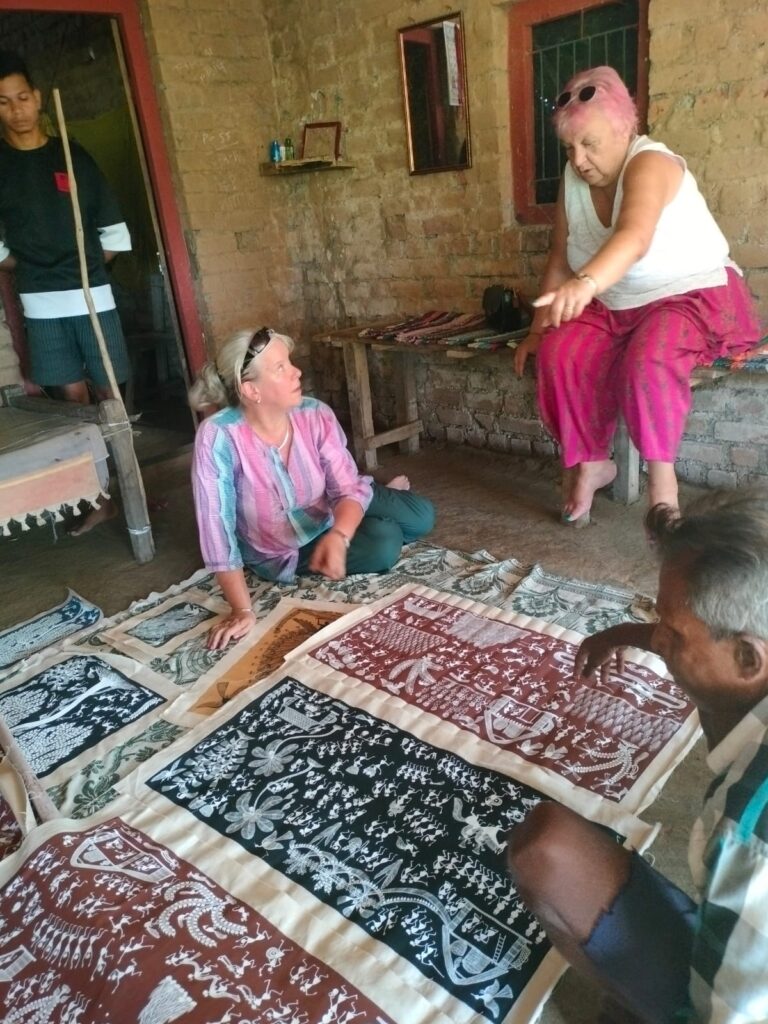
Warli painting is a form of tribal or folk art depicting everyday life in the Warli Villages in Maharashtra. The Warli tribe is one of the largest tribes in India, they are located North of Mumbai. I was lucky enough to visit the small village of Raitali close town of Dahanu where we were welcomed by Nathu Dehu Sutar father of the family and Subash his son both of whom are artists and the other family members. Nicola returned after about 10 years and I was very happy to be invited to join her, things have changed over that time but for the good. Electricity has come and a new water tank so the villagers are not reliant on the village well. Also bottled gas can now be delivered by truck so the lunch that we devoured was cooked on a gas ring not a cow dung fire. As well as the road in there is now a footbridge cross the stream which enables access to the health centre now as well as the market. I have been fascinated with the art work for a long time and loved doing the research and visiting the village, read on to discover more…..’’>?<<<<<M
The earliest Warli paintings are thought to date back to the 10th century and the their canvases were the mud walls of their huts so very similar to cave paintings elsewhere. The pictures told the stories of their lives, the passage of the seasons, the images of the farming and them also the celebrations of their festivals with dance featuring often.
The drawing style uses basic shapes to create the paintings: circles, triangles and squares, each shape has its own meaning as well…circles for the sun and moon, triangles for the hills and mountains and the conical shaped trees finally the square being the animal shelters, huts and houses so man made spaces.
The people and their animals are represented by two triangles joined by their tip, this way it is easier to animating the bodies to show movement. The bigger triangle on top denotes the man and the larger one at the bottom depicts the women also the women has a small dot by their head meaning their hair.
Aside from the day to day story telling of life, you will see the painting that is of the Tarpa Dance. The Tarpa is like a trumpet and when the men of the village start to play the rest join hands and follow him, he plays two notes and depending on the note he plays depends whether you turn left of right, but most importantly you must never turn your back on the Tarpa player. In the end you have a large snake of people and the Tarpa player acts like a human snake charmer. The circle that is formed is often thought to resemble the circle of life.
Traditionally the paintings were done on the walls of the huts and a new painting came with each significant life event. The paint was made from ground white rice flour worked into a paste with water and gum. A piece of bamboo was chewed to create a brush. Now the paintings you see are painted on cotton cloth and a red ochre square is laid down and then the white is painted on top in the same way.